


The Invisible Nervous System Behind Every Checked Bag
Most passengers see a suitcase disappear behind a rubber curtain at check-in and assume it enters a kind of mechanical void, a parallel universe where it will eventually reappear at the destination carousel like clockwork.
In reality, that brief moment is the start of one of the most tightly choreographed logistics systems in modern transport. Airline baggage handling is less a conveyor belt process and more a distributed intelligence network, stitched together by scanners, conveyors, databases, and human decision points that operate under relentless time pressure.
Every bag is treated as a moving data object. It is tagged, scanned, rerouted, and verified multiple times before it ever reaches an aircraft hold. The system is designed not only to move luggage efficiently but to prevent chaos from cascading when something inevitably goes wrong.
Because despite all the automation, baggage handling is still vulnerable to delay, misrouting, and disruption. Weather shifts, tight connections, aircraft swaps, and human error all introduce friction into what looks like a seamless process.
And when that friction results in a missing bag, an entirely different system activates behind the scenes.
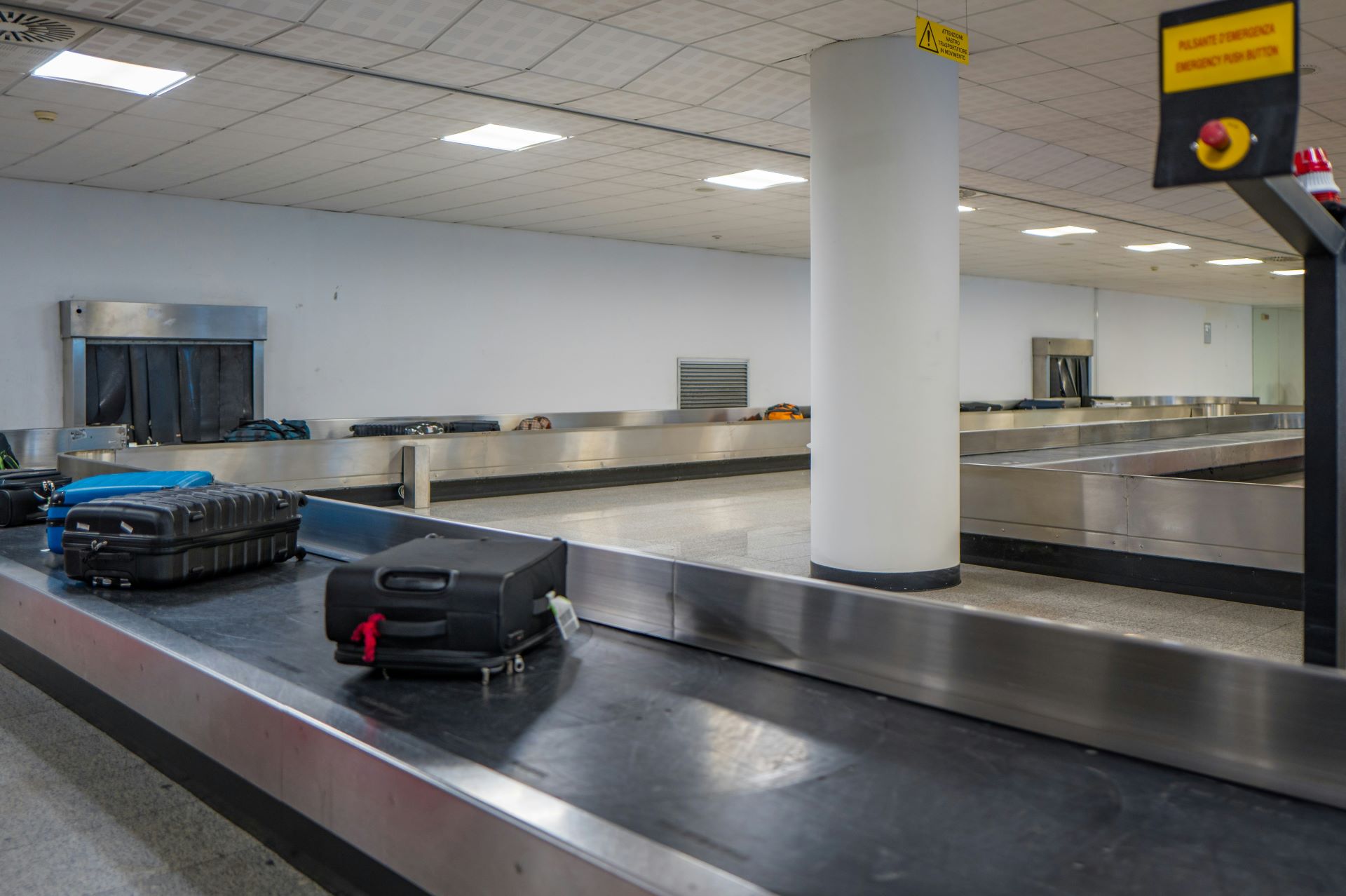
Where Lost Luggage Actually Begins
Lost luggage rarely means “lost” in the literal sense. In most cases, the bag is delayed, misrouted, or temporarily separated from its passenger’s travel itinerary.
The root causes are usually operational rather than mysterious. Tight connection windows are one of the most common factors, especially at major hub airports where bags may need to transfer between terminals or even between airlines. A delay of just a few minutes can break the chain of transfer timing.
Another frequent cause is baggage tag misreads or physical damage to labels. A partially torn barcode can send a bag down the wrong routing branch in a split-second automated decision.
Aircraft changes also play a role. When an airline swaps aircraft types due to maintenance or demand, baggage holds may differ in capacity and configuration, forcing last-minute reshuffles that increase the risk of misplacement.
Then there are systemic disruptions. Severe weather, security alerts, and airport congestion can overwhelm sorting facilities, causing bottlenecks that ripple through baggage networks for hours.
In all of these scenarios, the bag is not gone. It is simply off the intended path.
The Technology That Keeps Bags Visible
Modern baggage systems rely heavily on tracking technologies that allow airlines to maintain a digital footprint for each piece of luggage.
The most widely used system is barcode-based tracking. Every checked bag receives a unique tag printed at check-in, which is scanned at multiple points: drop-off, sorting, loading, unloading, and arrival carousel. Each scan updates a central database that records the bag’s last known location.
More advanced systems are now integrating RFID technology. Unlike barcodes, RFID tags do not require line-of-sight scanning. They can be read automatically as bags pass through sensor gates, improving accuracy and reducing manual intervention.
Airports that have invested in RFID infrastructure report significantly lower mishandling rates because fewer bags “disappear” between scan points.
Alongside physical tracking systems, airlines rely on integrated software platforms that map baggage journeys in real time. These systems correlate passenger itineraries with bag locations, automatically flagging mismatches when a passenger arrives but their bag does not.
In many cases, the system already knows something is wrong before the passenger reaches the baggage desk.
The Moment a Bag Becomes “Lost”
The transition from delayed to officially lost is not immediate. Airlines typically follow a structured classification process.
If a bag does not arrive on the same flight as its passenger, it is first marked as “delayed.” Ground staff begin tracing its last scanned location using baggage handling system logs.
If the bag remains unlocated after a set period, usually ranging from 24 to 72 hours depending on airline policy, it may be escalated to “missing” status.
At this point, a formal Property Irregularity Report is generated. This report acts as the operational anchor for recovery efforts. It contains passenger details, bag description, routing history, and any identifying features such as brand, color, or contents.
This is also where global baggage tracking systems begin cross-airline coordination, particularly for international itineraries involving multiple carriers.
The terminology matters because it determines how aggressively the recovery process is prioritized and what compensation rules may apply under international aviation agreements.
Inside the WorldTracer Network
One of the most important tools in global baggage recovery is WorldTracer, a shared system used by most major airlines to track and match lost baggage reports with found items.
When a bag goes missing, its details are entered into the system. If another airport or airline finds an unclaimed bag, that information is also logged. The system continuously cross-references entries, looking for matches based on descriptions, tag numbers, and routing data.
This creates a global matching engine that operates much like a search algorithm, connecting fragmented information across airports and countries.
A bag lost in Johannesburg might surface in Dubai or London, not because it was intentionally rerouted, but because it followed a valid but unintended transfer path.
The strength of this system lies in its scale. The more participants feeding data into it, the higher the probability of recovery.
The Human Layer That Machines Cannot Replace
Despite the sophistication of tracking systems, human intervention remains essential.
Baggage service agents act as investigators. They interpret scan histories, contact other airports, inspect storage areas, and manually verify bag descriptions. In many cases, they physically walk the baggage halls looking for items that were misfiled or overlooked by automated systems.
There is also a significant communication component. Agents coordinate across time zones, airline partners, and ground handlers, often working through fragmented information and incomplete data.
Some recovery cases depend entirely on human intuition. A misread tag that looks correct in the system might be spotted as inconsistent by an experienced handler familiar with routing patterns.
In aviation logistics, technology narrows the search. People finish it.
Sorting Hubs: Where Complexity Peaks
Large hub airports are where baggage systems reach their highest complexity.
These facilities process thousands of bags per hour, each one moving through a labyrinth of conveyor belts, diverters, scanners, and loading zones. The system is designed for speed, but also for redundancy. If one path fails, another is immediately available.
However, this redundancy introduces complexity. Bags may be rerouted multiple times in a short window, especially during peak travel periods.
Transfer bags are particularly vulnerable. These are bags that do not originate or end at the hub but must pass through it quickly to reach connecting flights. Their timing window is narrow, and any delay in upstream flights can cause cascading misalignment.
Modern hubs use predictive algorithms to manage this flow, attempting to anticipate congestion and dynamically adjust routing paths. But even these systems rely on accurate real-time data, which is not always guaranteed.
Why Some Bags Travel Without Their Owners
One of the most frustrating travel experiences is arriving at a destination while your bag takes a different journey entirely.
This typically happens when connection windows are too tight. Airlines may still accept the transfer because the system calculates that it is technically feasible, but in practice, even small delays can disrupt the sequence.
Another common cause is interline travel, where multiple airlines are involved in a single itinerary. Each carrier may use different baggage handling standards, and the handoff between systems introduces vulnerability.
There is also the issue of last-minute gate changes. When aircraft are reassigned gates or swapped entirely, baggage already en route to a specific loading zone may need to be redirected quickly.
In these moments, speed becomes the enemy of certainty.
Recovery Logistics: The Journey Back to the Passenger
Once a lost bag is identified, recovery begins as a reverse logistics operation.
The bag is retrieved from its current location, verified against its tracking record, and reintroduced into the baggage network. It is then rerouted to the passenger’s destination or, in some cases, delivered directly to their accommodation.
This process often involves multiple handoffs between ground handling companies, courier services, and airline staff.
International recoveries add further complexity due to customs regulations. A bag may need to be cleared before it can be transported across borders again, even if it is simply being returned to its owner.
Airlines prioritize recovery speed because delayed baggage directly impacts customer satisfaction metrics and operational reputation.
Communication: The Most Critical Touchpoint
For passengers, the most important part of the lost luggage process is not the technology. It is communication.
Airlines increasingly use digital tracking portals where passengers can check the status of their bag in real time. These systems often mirror internal tracking data, giving customers visibility into recovery progress.
SMS and email notifications are also widely used, particularly for updates such as “bag located,” “in transit,” or “out for delivery.”
However, communication gaps still occur, especially when baggage systems are fragmented across multiple carriers or ground handlers.
A well-managed recovery process is often defined not just by how quickly a bag is found, but by how clearly the passenger is kept informed along the way.
The Economics of Lost Baggage
Lost baggage is not just an operational issue. It is an economic one.
Each mishandled bag carries a cost that includes storage, transport, customer service time, and potential compensation. For airlines operating at scale, even small reductions in mishandling rates translate into significant financial savings.
This is why investment in tracking technology has accelerated in recent years. RFID deployment, automated scanning gates, and integrated software platforms are all part of a broader strategy to reduce loss rates.
Airports also benefit economically. Efficient baggage systems improve throughput, reduce congestion, and enhance overall passenger experience, which can influence airport ratings and airline partnerships.
The Future of Baggage Intelligence
The next evolution in baggage handling is predictive intelligence.
Rather than simply tracking bags, future systems aim to predict risk. By analyzing flight delays, transfer patterns, and historical mishandling data, algorithms can flag bags that are likely to be delayed before they actually go missing.
Some airports are already experimenting with real-time rerouting suggestions, automatically adjusting baggage paths based on live conditions.
There is also growing interest in passenger-level baggage visibility, where travelers can track their bags in real time through mobile apps with near-GPS precision.
In this future, lost luggage may become less of a mystery and more of a preventable exception.

A System Built to Reunite
Lost luggage feels personal because it interrupts the most intimate part of travel, the belongings we trust to move with us.
But behind the scenes, baggage handling is one of the most resilient logistics systems in the world. It combines automation, data intelligence, and human expertise in a constant effort to keep pace with global travel complexity.
When a bag goes missing, it is not a disappearance. It is a deviation. And somewhere inside a network of scanners, databases, and dedicated staff, the path back is already being traced.